
| Basic Definition Three-way matching is an accounts payable control process that compares three core documents before a payment is approved. The three documents are: the purchase order (PO), goods receipt, and supplier/vendor invoice. If all three documents agree on the items, quantities, and cost, the invoice will be paid; otherwise, it will be held until the mismatch is resolved. |
Quick Summary
- The purchase order (PO), goods receipt note (GRN), and vendor invoice are compared.
- Best for physical goods, services, and inventory purchases.
- A standard financial control best practice, but not legally required.
- Manual processing can take hours per invoice, while automation reduces this to minutes.
- Other related controls include two-way matching (PO + invoice only) and four-way matching (adds a quality/inspection report).
Overpaying, paying for undelivered goods, or missing invoices can hurt your cash flow and supplier relationship. Three-way matching in accounts payable(AP) is an essential practice to ensure accuracy in handling vendor payments. In this comprehensive guide, you’ll find the basics, a clear definition, an example, and the process of how 3-way matching works. You’ll also learn more about differences between two-way, three-way, and four-way matching, the best practices, and the advantages of automating this process.
| Key Terms to Know Goods Receipt Note (GRN)/Receiving Report: A document the receiving team/department creates to confirm the quantity and condition of the delivered goods/services. Invoice Hold: When an invoice fails the 3-way matching, it is kept in a status called ‘Invoice Hold’. The invoice is cleared from this status only when the mismatches are resolved. Matching Tolerance: It is an acceptable limit of variance within which the discrepancy is automatically accepted rather than flagged as an exception for manual review. |
What Is Three-Way Matching in Accounts Payable?
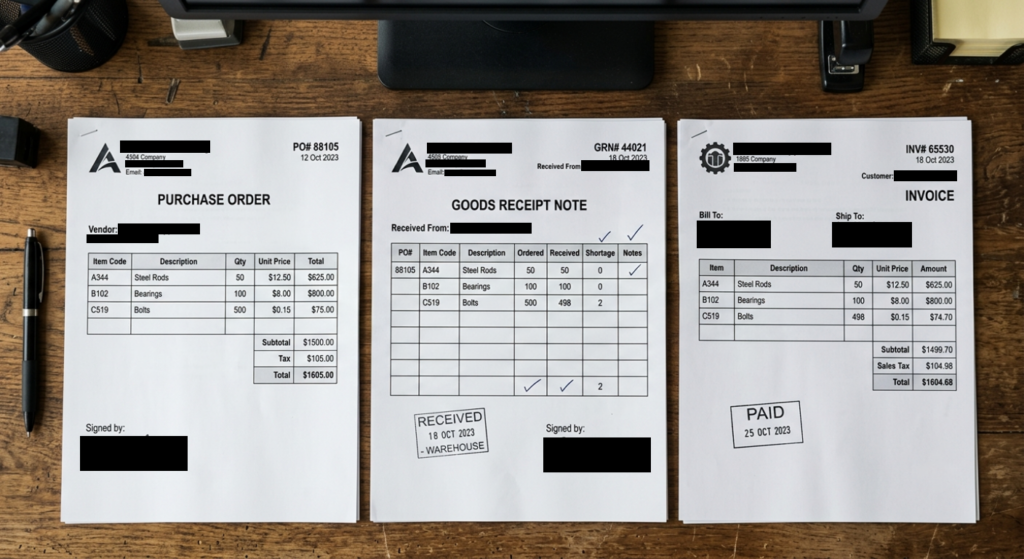
Three-way matching is an accounts payable control that compares the purchase order, goods receipt, and vendor invoice before a payment is approved. It’s an internal control process used by businesses to verify that vendor invoices are accurate before releasing payment, by cross-checking three core documents:
- Purchase Order (PO) – It is generated internally by a business before placing an order and defines what was ordered, including item details, cost, quantity, and delivery terms.
- Receiving Report (SRN/GRN) – A document created by the warehouse or receiving department that confirms what was actually delivered by the vendor and its condition.
- Vendor Invoice – It is sent by the vendor after the goods/services are delivered, requesting payment based on the agreed terms.
The invoice is approved only if all three documents align on quantity, items, and cost. If there’s a mismatch, it’s flagged for review. This process is the foundation of effective 3-way invoice matching, helping reduce the risk of both payment errors and fraud.
5 Steps of Three-Way Matching in AP
- A purchase order (PO) is created.
- The supplier delivers the goods or services to the business.
- The receiving team creates a goods receipt to confirm what was received from the vendor.
- The vendor sends an invoice to the business requesting payment.
- The AP team (or an automated system) checks the PO, goods receipt, and invoice for mismatches. If all three match, the invoice is approved for payment; if not, it’s held for review.
An Example of Three-Way Matching in Accounts Payable
Imagine your business orders 500 units of cleaning material at AED 10 per unit:
- Purchase Order (PO): 500 units @ AED 10 = AED 5000
- Goods Received Note: only 480 units were delivered
- Vendor Invoice: 500 units @ AED 10 = AED 5000
In this scenario, there is a difference of 20 units. The AP will flag this difference before payment is approved. The vendor will be asked to either deliver the remaining units or send a corrected invoice.

Why Three-Way Matching Is Important
Prevents Overpayments
Without this control process, businesses will leak money by paying for goods or services they didn’t receive or paying incorrect amounts to suppliers.
Detects Fraud or Errors
Invoice fraud and billing errors pose significant risks for AP teams in all industries. Three-way matching helps prevent payment of duplicate invoices, inflated prices, and unauthorized purchases.
Improves Vendor Communication
Finding mismatches early can help businesses resolve them faster with the suppliers. Three-way matching supports enable a smooth payment process and reduce the risk and complaints from both the business and the vendor.
Enhances Audit Compliance
Audit readiness is essential for AP teams. Implementing controls like three-way matching strengthens the audit trail and demonstrates financial regulatory compliance.
When and How a Three-Way Match Is Performed
The three-way matching in Accounts Payable begins before the payment is processed. Once the AP department receives the invoice, it triggers the three different matching processes:
- Match 1: PO vs. Invoice
- Match 2: Invoice vs. Goods Receipt
- Match 3: PO vs. Goods Receipt
Only when all three match does the system or AP team approve the invoice for payment.
Two-Way vs. Three-Way vs. Four-Way Matching
All three are control processes to handle risks and discrepancies in vendor payment processes. Two-way matching compares only the PO and invoice, which is faster but doesn’t verify if the goods have actually arrived. Three-way matching adds the receiving receipt for a more complete check.
Four-way matching brings an additional document into the process. It adds a quality or inspection report, hence providing an extra layer of verification beyond quantity and price.
| Feature | Two-Way Match | Three-Way Match | Four-Way Match |
| Documents compared | PO and Invoice | PO, Invoice, and Goods Receipt | PO, Invoice, Goods Receipt, and Inspection/Quality Report |
| Risk of errors | Higher | Lower | Lowest |
| Use case | Service-based purchases | Inventory/physical goods | Regulated or quality-critical industries (like healthcare) |
Two-way matching is ideal for services, while three-way matching is best for physical goods and inventory. On the other hand, four-way matching in Accounts Payable is more time-consuming because it adds an extra step to assess the quality and condition of the goods or services delivered. That’s a main reason it’s reserved for industries where quality or compliance inspection is a regulatory requirement.
5 Common Causes of Three-Way Match Exceptions
Even with strict controls, all three matches may not align on the first attempt. Some of the main reasons for these are:
- Quantity mismatches from partial or split shipments
- Pricing issues like stale pricing, a missed discount, or currency conversion differences on international orders
- A missing or incorrect PO number on the invoice
- Duplicate invoice submissions from the vendor
- Item or SKU substitutions made by the supplier without prior notice
When an exception is flagged, the AP team contacts the vendor or the internal receiving or purchasing team to resolve the issue before payment is released.
Best Practices for Three-Way Matching in Accounts Payable
- Leverage AP automation platforms for efficient document matching. Automating 3-way matching ensures greater accuracy and reduces time compared to the manual process.
- Set tolerances for minor discrepancies. A Matching Tolerance will allow smaller, lower-risk discrepancies to be processed without flagging for manual review.
- Regularly train staff to recognize red flags on invoices.
- Maintain centralized document management for faster access.
- Integrate with inventory management for real-time validation.
How to Automate Three-Way Matching in AP
Manual matching is time-consuming and error-prone. Businesses are increasingly automating the three-way match using:
- Optical Character Recognition (OCR) to scan and digitize invoices
- ERP systems that link POs, invoices, and receipts
- Workflow automation that routes invoices and exceptions for approval
Automation reduces manual effort, accelerates the AP cycle, and minimizes human error.
How Serina Automates Three-Way Matching
If your AP process still relies on manually comparing printed POs, receipts, and invoices, this is exactly where an automation tool like Serina fits in. Serina’s AI-driven platform automates the three-way match by extracting invoice data and comparing it with POs and GRNs, integrating with your existing finance environment to pull the relevant data and routing exceptions through automated workflows for quick resolution. That means less manual cross-checking, faster exception handling, and a full audit trail, even if your ERP was recently implemented.
In addition to matching, the platform manages automated data validation, exception management, invoice routing, classification by vendor and cost center, GL-code posting, and near-real-time analytics on spending patterns and process bottlenecks. This provides visibility into the frequency and causes of match failures, rather than just a pass or fail result for each invoice.
Automated three-way matching in Accounts Payable is widely used across industries such as manufacturing, retail, healthcare, construction, and food and beverage. If you are considering using AP automation tools, read more about how 3-way invoice matching functions within Serina before deciding whether to adapt your current ERP or implement a dedicated solution.