| Summary A purchase requisition (PR) is a formal internal request from an employee or department to the procurement team to authorize the purchase of goods or services. It is not a commitment to a vendor. It is an internal control document that triggers budget verification and approval before creating any external obligation. Once approved, the requisition becomes a purchase order, the binding document sent to the supplier. In the procure-to-pay (P2P) cycle, the purchase requisition is the first and most important control point. |
Every uncontrolled purchase starts the same way: someone in the business needs something, contacts a vendor directly, and the invoice lands in AP weeks later with no purchase order, no budget approval, and no paper trail. Finance spends hours chasing down the approver, the cost hits the wrong cost center, and the controller has another exception to explain at month-end.
The purchase requisition prevents this. It is the internal checkpoint that stands between an employee’s intention to spend and the company’s actual commitment to a vendor. When the requisition process works, spend is visible before it happens, budgets are protected, and the path from request to payment is documented at every step.
This guide covers what a purchase requisition is, how it moves through the approval workflow, how it converts to a purchase order, where it sits in the broader procure-to-pay cycle, and what breaks down when organizations manage it manually.
What Is a Purchase Requisition?
A purchase requisition is a structured internal document through which a department formally requests authorization to procure specific goods or services. It captures the who, what, why, and how much before the organization commits to an external party.
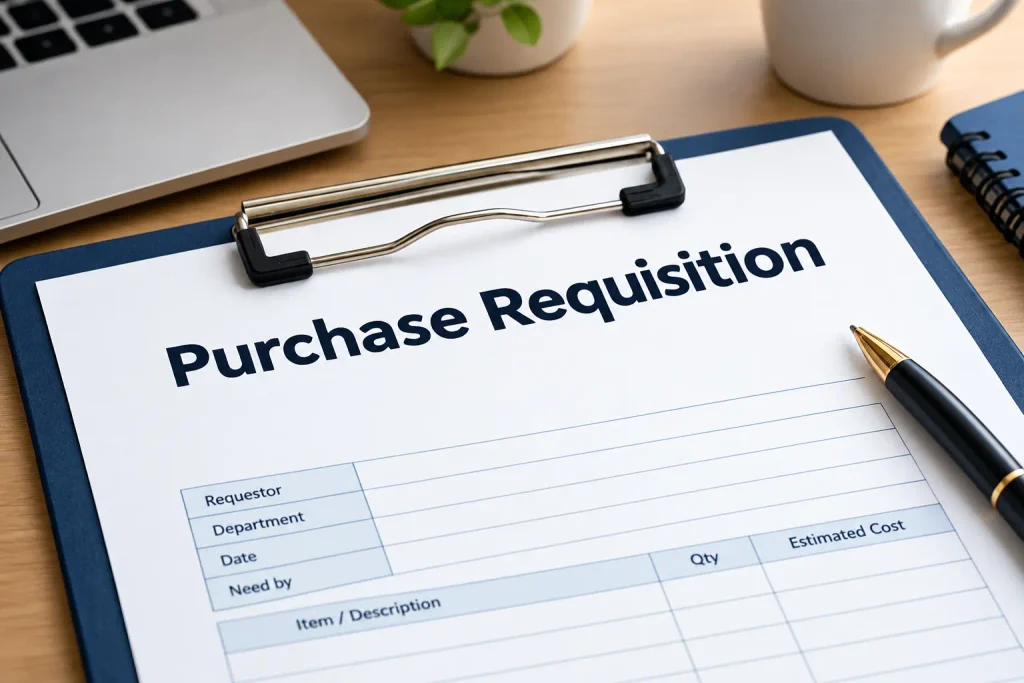
A complete purchase requisition typically includes:
- Requester name and department
- Description and quantity of goods or services needed
- Estimated cost and preferred vendor (if known)
- General ledger account and cost center allocation
- Required delivery date
- Business justification
- Supporting documentation such as quotes or specifications
The purchase requisition does not authorize payment and is not sent to the supplier. Its function is entirely internal: to verify that a spending need exists, that budget is available, and that the right people have approved the request before procurement acts on it.
Purchase Requisition vs Purchase Order: The Critical Difference
Outside finance, the terms are often used interchangeably, but they serve fundamentally different functions. Conflating the two is one of the most common sources of procurement control failures.
| Purchase Requisition | Purchase Order | |
| Who creates it | Requesting department or employee | Procurement or AP team |
| Who receives it | Internal approvers only | Vendor/supplier |
| Legal commitment | None; internal document only | Yes; binding commercial document |
| Purpose | Request and authorize spend internally | Instruct vendor on what to deliver and at what price |
| Budget impact | Encumbers (reserves) budget | Commits budget |
| Comes first? | Yes | After PR approval |
The sequence matters: no purchase order should be issued without an approved purchase requisition. When procurement receives a PR that has passed budget and approval checks, they use it as the basis to issue a PO to the vendor. This creates the documented authorization chain that auditors and controllers need to trace spend back to its source. Learn how Serina automates this process in the PO automation guide.
How the Purchase Requisition Process Works
The purchase requisition process follows a defined sequence from request to PO conversion. In a well-run procurement environment, each step is documented and traceable.
Step 1: The requester submits the PR
An employee or department manager identifies a spending need and completes a purchase requisition form, either on paper, in a spreadsheet, or in the ERP/procurement system. The PR includes item description, quantity, estimated cost, preferred vendor, GL code, and business justification.
Step 2: Budget verification
The system or the finance team checks that adequate budget exists in the relevant cost center and GL account to cover the requested spend. In automated environments, this check happens instantly. In manual environments, it often requires an email exchange with finance and can take days.
Step 3: Approval routing
The PR is routed to the appropriate approver or approval chain based on the dollar amount, department, spend category, or combination. Low-value requests may require only line-manager approval. Higher-value or capital requests may require VP, CFO, or committee sign-off.
Step 4: Procurement review
Once approved, the procurement team reviews the PR for vendor selection, contract compliance, and catalog adherence. If the requester named a preferred vendor, procurement confirms they are an approved supplier and that pricing is within contracted terms.
Step 5: Conversion to purchase order
The approved PR is converted into a purchase order and issued to the vendor. The PO references the original PR, creating a traceable link between internal authorization and external commitment.
Step 6: Goods or services are delivered
The vendor fulfills the order. Upon receipt, the system creates a goods receipt record and matches it to the PO, preparing for the three-way match when the vendor invoice arrives.
Step 7: Invoice receipt and three-way match
When the vendor invoice arrives, AP matches it against the PO and the goods receipt. This three-way match confirms that what was ordered, what was received, and what the vendor charged all agree, enabling payment to be released.
The three-way match makes the purchase requisition’s value fully visible. Because the PR created the PO, and the PO governed the delivery and the invoice, the entire spend event is documented from the original internal request through to payment. See how this works in the three-way matching guide.
Where the Purchase Requisition Fits in the Procure-to-Pay Cycle
The procure-to-pay (P2P) cycle is the end-to-end process from identifying a purchasing need to paying the supplier. The purchase requisition is the first formal step in this cycle and determines whether the rest of the process is controlled or ad hoc.
The P2P Cycle: Where Purchase Requisition Fits
1. Purchase Requisition (PR)
2. PR Approval and Budget Check
3. Purchase Order (PO) Issued to Vendor
4. Goods or Services Delivered / Goods Receipt
5. Invoice Received from Vendor
6. Three-Way Match (PO + GR + Invoice)
7. Invoice Approval and Payment
Organizations that skip the purchase requisition step, or allow employees to raise POs directly without an approved PR, lose the critical first control point. Without it, there is no budget encumbrance before commitment, no documented approval before the vendor obligation is created, and no clean audit trail from business need through to payment.
For CFOs and Controllers, the purchase requisition is where budget visibility starts. If the requisition process is weak, every downstream control, from PO approval to invoice matching, is operating on a shaky foundation.
Where Manual Purchase Requisition Processes Break Down
Most procurement inefficiency and control risk starts at the requisition stage. These are the failure modes that finance teams most commonly encounter with manual or paper-based PR processes:
- No approval trail: paper- or email-based requisitions are approved informally, with no timestamped record of who approved what and when. Audit requests reveal approvals that cannot be substantiated.
- Off-catalog buying: without a system that routes requesters to approved vendors and contracted pricing, employees contact preferred vendors directly, bypassing negotiated rates and creating unauthorized supplier relationships.
- Slow requisition-to-PO conversion: manual hand-offs between the requester, approver, and procurement team mean days pass between request and PO issuance. Vendors receive inconsistent instructions and delivery timelines slip.
- Budget checks that happen too late: when finance verifies budgets manually after the fact, commitments are made without confirmed budget availability. Overruns are discovered at month-end rather than at the point of request.
- Invoice exceptions caused by missing POs: when a purchase happens without an approved PR and PO, AP receives an invoice with nothing to match it against. The invoice enters an exception queue, approval is chased manually, and payment is delayed, damaging vendor relationships.
- Duplicate or unauthorized spend: without centralized visibility into open requisitions and purchase orders, the same goods can be requested twice, or spend can occur outside of any approval framework entirely.
How Automated Purchase Requisition Processes Fix These Problems
Automating the purchase requisition process replaces each of the manual failure modes above with a controlled, documented, system-enforced workflow:
- Digital approval workflows: approval routing rules based on dollar threshold, spend category, and department ensure that every PR reaches the right approver automatically, with a timestamped audit log of every decision.
- Catalog and vendor controls: requesters select from approved catalog items and approved suppliers, keeping spend within contracted terms and preventing off-catalog purchases.
- Real-time budget encumbrance: budget is checked and reserved at the point of PR submission, not after the fact. Requesters see available budget before submitting, and approvers are alerted if a request exceeds the remaining budget.
- Automated requisition-to-PO conversion: once a PR is approved, the system generates the PO automatically from the PR data, eliminating manual re-keying and delays between approval and vendor notification.
- Closed-loop P2P visibility: every spend event, from the original PR through PO, goods receipt, and invoice, is linked in a single traceable record that finance and procurement can review in real time.
For AP teams, the downstream benefit is equally significant. When every invoice that arrives has an authorized PO behind it, and every PO has an approved PR behind that, three-way matching becomes the norm rather than the exception. Invoice exception queues shrink because the authorization chain was built correctly from the start. The invoice approval workflow guide covers how this works end to end, and the AP KPIs guide covers how to measure the improvement.
How Serina Manages the Purchase Requisition Process
Serina’s procure-to-pay platform automates the purchase requisition process from initial request to PO issuance, giving finance teams the budget visibility and approval documentation they need, and giving AP teams the clean PO coverage that makes invoice matching straightforward.
- Configurable approval workflows: set approval rules by amount, department, spend category, or any combination, with automatic escalation and a timestamped approval log for every requisition.
- Automated PR-to-PO conversion: approved requisitions convert to purchase orders without manual re-entry, with the PR reference embedded in the PO for full traceability.
- Real-time budget visibility: budget encumbrance at PR submission gives controllers accurate committed spend before obligations reach vendors.
- Seamless AP integration: when vendor invoices arrive, Serina automatically matches them against the PO and goods receipt, reducing the exception rate that manual PR processes leave behind.
Ready to see how Serina handles purchase requisitions from request to payment? Book a Serina demo to walk through the full P2P workflow.
Conclusion
The purchase requisition is the first question every P2P cycle asks: is this spend approved? When the answer is documented, budget-verified, and traceable, everything that follows- the PO, the goods receipt, the invoice match, the payment- builds on a solid foundation. When the answer is an informal email or a verbal agreement, the foundation is missing, and AP spends its time rebuilding it manually every time an invoice arrives.
Building a controlled purchase requisition process is not a procurement initiative in isolation. It is one of the most direct investments a CFO or Controller can make in the reliability of their procure-to-pay cycle and the accuracy of their AP function.
Frequently Asked Questions
Is a purchase requisition the same as a purchase order?
No. A purchase requisition is an internal document requesting authorization to buy. A purchase order is the external document sent to the vendor committing to a purchase. The PR comes first; the PO follows only after the PR is approved.
Do all purchases need a purchase requisition?
Most organizations exempt very low-value purchases, petty cash transactions, and emergency procurement below a defined threshold. Above that threshold, a purchase requisition is required for every controlled spend category. The organization’s procurement policy should define the threshold and exempt categories.
What happens to the PR after it is approved?
The procurement team converts an approved purchase requisition into a purchase order. The PO references the original PR to preserve the full authorization trail. The requester is typically notified of approval and PO issuance, and the PO is sent to the vendor to fulfill the order.
What is the difference between a blanket PR and a standard PR?
A standard purchase requisition covers a specific one-time purchase. A blanket requisition authorizes recurring purchases from a specific vendor up to an agreed total value over a defined period, typically used for regular services or consumables. Blanket requisitions reduce the administrative burden of raising individual PRs for each recurring order while preserving the budget and approval control structure.