Introduction
As a business owner, using different invoice payment terms is part of your work. Unclear or inconsistent invoice terms will lead to delayed payments, frequent disputes, unpredictable cash flow along with strained vendor relationships. On the other hand, well-defined terms create transparency, improve cash flow predictability, and reduce friction across finance operations.
This guide talks about what invoice terms and conditions are, why they matter in B2B transactions, the most common invoice payment terms and conditions and examples of 15 most common invoice payment terms.
What are Invoice Terms and Conditions: Definition and Importance
Invoice terms and conditions are the set of rules and expectations attached to an invoice that define how and when a payment should be made. When you receive an invoice from a vendor, the payment terms outline everything you need to know to process that payment accurately and on time.
Clear and well-defined payment terms are essential for maintaining smooth financial operations and minimizing risk. Here are the benefits it provides:
Clarity and consistency
Clearly stated terms eliminate confusion around payment timelines, methods and responsibilities, helping you process invoices efficiently.
Steady cash flow and visibility
Defined due dates and payment conditions help you plan and manage cash outflows in a better way, making sure you meet obligations without disrupting operations.
Legal and compliance assurance
Payment terms act as a formal reference in case of disputes and support compliance with tax and regulatory requirements.
Sets stronger vendor relationships
Adhering to transparent and agreed-upon terms builds trust with vendors and ensures smoother collaboration.
Lesser risk of penalties and disputes
Understanding terms such as late fees or special conditions helps you avoid unnecessary costs and payment-related conflicts.
What’s included in invoice payment terms?
While the specifics may vary between vendors, most invoice terms typically include:
- Payment due dates
- Accepted payment methods
- Late payment penalties or charges
- Tax details and compliance requirements
- Any special conditions that affect your payment obligations
- Early payment or trade discounts you can take advantage of
- Clear instructions on how to make the payment
- Relevant details that impact the timing, method and total amount payable
In simple terms, payment terms cover everything you need to be aware of before releasing payment.
See Automated Invoice Processing in Action
Watch how Serina automates invoices with its AI-powered ingestion, three-way matching, validation, approval routing, ERP integration and reconciliation. See how you can eliminate disconnected decisions from happening and speed up approvals and full visibility across your AP process without increasing headcount.
15 Invoice Terms and Conditions with Examples
From payment timelines and early payment discounts to delivery-based and milestone-based terms, each condition states how and when payments should be made.
Below are 15 commonly used invoice payment terms with examples to help you better understand their meaning and impact on invoice processing.
| Payment Term | Abbreviation | Definition | Example | When Payment Is Due | Best For |
| Net Terms | Net 7 / 15 / 30 / 60 / 90 | Payment is due within a fixed number of days from the invoice date | Net 30 means payment is due within 30 days | 7–90 days after invoice date | Standard B2B procurement transactions |
| End of Month | EOM | Payment is settled by the end of the invoice month | Invoice dated June 12 is payable by June 30 | Last day of invoice month | Ongoing vendor contracts in GCC and APAC markets |
| Month Following Invoice | 15 MFI | Payment is due on a fixed date in the month following invoicing | 15 MFI means payment is due on the 15th of the next month | Specific date in following month | Businesses with monthly billing cycles |
| Due Upon Receipt (Immediate Payment/Payable on Receipt) | — | Payment is expected immediately after invoice receipt | Invoice must be settled within 24 hours | Immediately upon receipt | Urgent procurement or service invoices |
| Early Payment Discount | 2/10 Net 30 | Discount is offered for making payments before the due date | 2% discount if payment is completed within 10 days | Within discount period or 30 days | Businesses optimizing working capital |
| Stage Payments | — | Payments are released in phases as project milestones are completed | 30% payment after completion of implementation phase one | Based on milestone completion | Construction, ERP, and IT projects |
| Contra Payment | — | Payments are adjusted against mutual outstanding balances between businesses | Vendor invoices are offset against shared services provided | As mutually agreed | Strategic vendor partnerships |
| Interest Invoice | — | Additional charges are applied for overdue payments | Vendor applies a 1.5% late fee on unpaid invoices | After payment due date | Managing delayed payments and compliance |
| Cash Account | CA | Payment must be settled immediately without extended credit terms | No credit offered or payment secured through a bank-issued letter of credit | At the time of transaction | Direct purchases and cross-border B2B trade |
| Cash in Advance (Payment in Advance) | CIA / PIA | Full or partial payment must be completed before goods, services, or projects begin | Vendor requests 100% advance payment before production starts | Before work or shipment begins | High-value purchases and new supplier relationships |
| Cash Before Shipment | CBS | Vendors dispatch goods only after receiving payment confirmation | Shipment is released after advance payment is verified | Before shipment | International trade and export orders |
| Cash on Delivery | COD | Payment is processed once goods are delivered | Payment is made when goods arrive at your warehouse | At delivery | Local procurement and distributor purchases |
| Cash with Order | CWO | Payment is required while placing the purchase order | Payment is submitted along with the order request | At the time of ordering | Manufacturing and made-to-order procurement |
Five Additional Invoice Terms and Conditions
1. Forward Dating
The invoice date is adjusted to a future date, giving your business additional time before payment terms begin.
Example: Goods are delivered on April 1, but the invoice is dated April 10 to extend the payment cycle.
2. One Month’s Debit
A single payment is made at the end of the month for the entire month’s supply or usage.
Example: Multiple deliveries made throughout June are consolidated into one invoice payable at month-end.
3. Installment Payments
Payments are divided into smaller scheduled amounts instead of a one-time settlement.
Example: A software implementation fee is paid in four quarterly installments.
4. Milestone-Based Payments
Payments are tied to completed deliverables or predefined project stages.
Example: Payment is released after successful ERP deployment and approval.
5. Advance Payment
A partial upfront payment is required before services or goods are delivered.
Example: Your vendor requests a 40% advance before production begins.
Example Invoice with Payment Terms
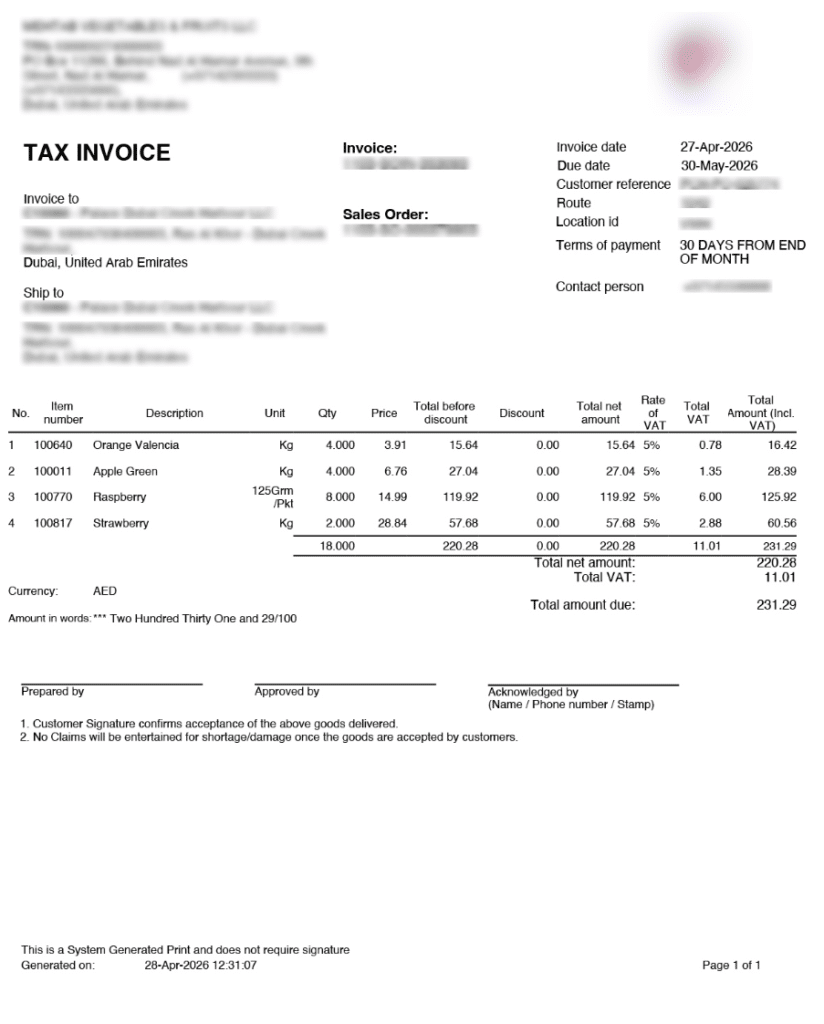
The tax invoice below features EOM-based payment terms, where the payment is due 30 days from the end of the invoice month.
A clear and standardized invoice terms and conditions should help in clearly answering the following questions:
- When should you make the payment?
- How should the payment be processed?
- What happens if the payment is delayed?
Also Read: How to Track Business Expenses: A Perfect Step-by-step Guide for Enterprises
How to Streamline Your Invoice Processing with Automation
For an organization of your size, managing high-volume invoices can slow down AP operations. The right software can reduce validation effort, eliminate duplicate payments and any compliance or process inconsistencies.
Serina, an AI-powered AP invoice processing automation platform streamlines the entire invoice lifecycle process, end-to-end with intelligent automation by helping your AP team save hours of operational time, eliminate process errors and approval delays, improve auditability and gain complete visibility while accelerating invoice processing end-to-end.
Conclusion
Invoice terms and conditions play its role in making sure all the payments are processed in time, accurately, with minimal disputes between you and vendors. Vendors usually specify accepted payment methods like bank transfers, cheques, direct debits, cash on delivery (COD), or online payment links, helping you to choose the best option as per your internal workflows.
To streamline your AP invoice process, contact Data Semantics – a leading AI-powered enterprise automation platform helping AP and finance teams modernize invoice operations with AI-driven workflows. It reduces invoice processing time to under a minute while enabling touchless processing, AI-led discrepancy handling, automated reconciliation and end-to-end auditability and compliance across the entire process.
Schedule a demo to see how you can achieve faster invoice processing, greater control and 100% visibility across your AP operations.
FAQs
- What are five payment terms?
The five major payment terms included in the invoice you receive are
– Net 30, Net 60, Net 90, Payment in Advance (PIA), Cash on Delivery (COD).
Net terms need payment within a pre-set timeline from the date of the invoice, whereas PIA needs payment before the services are delivered. Finally, COD means payment is due at the time of delivery. These terms help you and vendors have a clarity on payment timelines, cash flow and cut off payment-related disputes.
- What are the terms and conditions on an invoice?
Invoice terms and conditions are payment rules that are attached to your vendor’s invoice that states the how and when a payment should be made, along with pre-defined conditions. The terms consist of payment due dates, tax details, accepted payment methods, early payment discounts, penalties for late payments and any special contract-related conditions. For you, payment terms ensure invoices are accurately processed, approved on time and aligned with financial records, reducing risks of duplicate payments, compliance issues, unexpected charges and vendor disputes.
- What are the three types of invoices?
The three common types of invoices you receive from vendors are – recurring invoices, interim invoices and final invoices. Recurring invoices are issued at a fixed time for current services. Interim is used for long-term projects where payments are made in stages on finished milestones. Final invoices are issued after the whole project, or delivery is completed, with the remaining balance payable included.
- Is Net 60 better than Net 30?
Whether Net 60 is better than Net 30 will depend on your business’s cash flow needs and vendor agreements. Net 30 needs to be paid within 30 days of the invoice date, while Net 60 needs to be paid within 60 days. Net 60 gives flexibility in managing short-term cash flow for large purchases or longer project cycles and Net 30 is commonly used in many industries as it balances payment flexibility for you while ensuring vendors are paid within a set timeframe.
- What is an invoice query?
It is a question posed by you to the vendor on invoices issued by them. These queries are mostly about payment discrepancies payment term, incorrect invoice data, PO references, mismatched quantities, tax calculations and duplicate invoices, etc. They also help you verify the accuracy of invoices before the payment is released.